
Inside Texas’ Landmark Cannabis License Awards: A Once in a Generation Opportunity
 by Mitch on April 14, 2026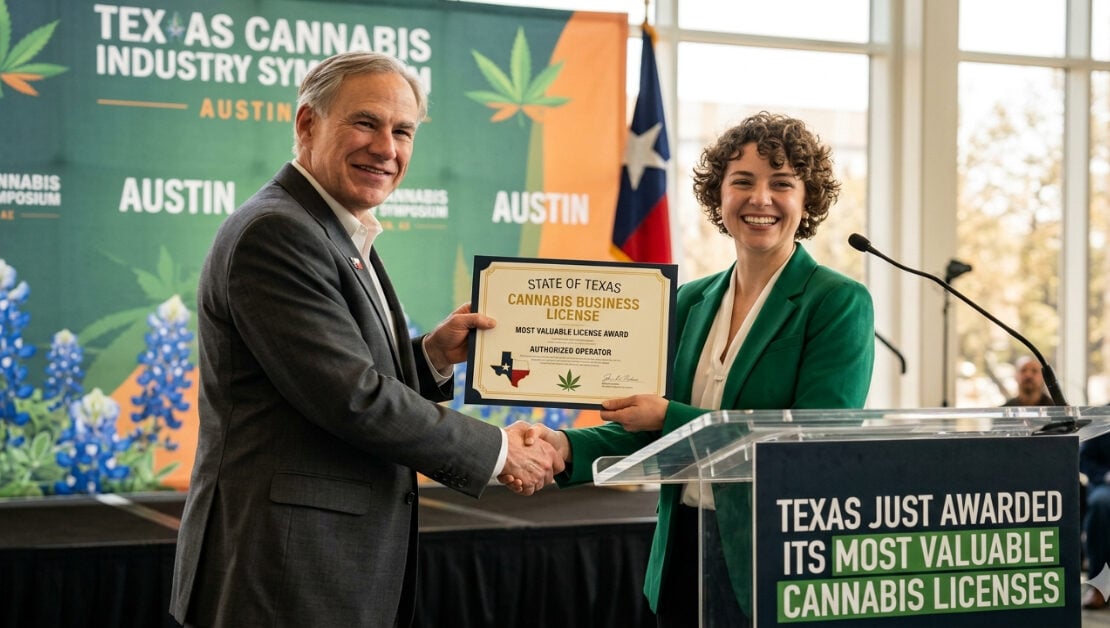
Texas Just Awarded Its Most Valuable Cannabis Licenses — Here’s What You Need to Know
The Texas cannabis market just reached a defining moment. In a state of 30 million people the second-largest in the nation — the government has now completed its selection of 12 new cannabis dispensing organization licenses. Only 15 total will ever exist in the entire state. If you’ve been watching this space, you already know what that means. If you’re just tuning in, keep reading — because the opportunity in front of you is unlike anything else.
What a TCUP License Actually Allows You to Do
A Texas dispensing organization license is not a retail-only permit. This is a vertically integrated license — one of the most powerful in the cannabis industry. Under Texas law, a licensed dispensing organization is authorized to:
Cultivate cannabis plants from seed to harvest, maintaining full control over the supply chain from the ground up.
Process and manufacture low-THC cannabis products, including a significantly expanded product menu under HB 46. The new law now allows edibles, tinctures, topical balms and lotions, transdermal patches, suppositories, and critically — pulmonary inhalation via approved devices such as nebulizers, vaporizers, and inhalers when medically necessary. The
old 1% THC by weight limit has been replaced with a far more workable standard: up to 10 milligrams of THC per dosage unit, with a package limit of 1 gram of total THC.
Distribute and dispense directly to patients who hold valid prescriptions from registered physicians through the Compassionate Use Registry of Texas (CURT).
Operate satellite locations — a game-changing new provision under HB 46 (more on this below).
HB 46 also dramatically expanded the qualifying patient conditions. In addition to the existing list covering epilepsy, autism, PTSD, ALS, cancer, multiple sclerosis, and other serious conditions, patients may now qualify with chronic pain (continuous or intermittent severe pain lasting more than 90 days), traumatic brain injury, Crohn’s disease and other inflammatory bowel diseases, and terminal illness or hospice and palliative care situations. This expansion of qualifying conditions dramatically widens the potential patient base for license holders.
The Satellite Location Advantage: A Major Value Driver
One of the most underappreciated provisions in HB 46 is the authorization of satellite locations for dispensing organizations. This is a critical piece of the puzzle for license holders and investors alike.
Prior to HB 46, TCUP dispensing organizations operated from a single, fixed location and had to serve patients across the entire state from that one site. Under the new law, licensed dispensing organizations can establish department approved satellite locations, physical storefronts where they can securely store and dispense their products to patients.
The framework currently allows one satellite location per public health region, until there is a dispensing organization in every region. Texas has 11 public health regions. That means a single license holder could potentially operate across multiple regions, establishing a legitimate brick- and-mortar retail presence in multiple markets throughout the state.
This is enormous. Each satellite represents a revenue center, a brand touchpoint, and a patient access point — all operating under the umbrella of a single vertically integrated license. For anyone evaluating the asset value of a TCUP license, the satellite location provision turns what might look like a single-location business into a scalable, multi-site operation. It also means the physical real estate requirements — and the real estate opportunities — are multiplying alongside the license itself.
The Path from Conditional Award to Full Operation
Understanding the roadmap from conditional selection to fully operational business is critical for anyone considering acquiring or investing in a TCUP license. Here is how it works:
Step 1 — Conditional Selection: DPS announces the conditional awardees (as just occurred in Phase I and Phase II). At this stage, the license is not yet active. The conditional license does not grant the holder permission to cultivate, manufacture, distribute, or sell any cannabis products.
Step 2 — Due Diligence Review: DPS conducts a thorough secondary evaluation of each conditional licensee, including review of disciplinary history, financial suitability, litigation history, and any other relevant factors. License fees are not invoiced until this review is completed and passed. Passing this step is not guaranteed, conditional status is not a final award.
Step 3 — Final License Issuance: Upon passing due diligence, DPS issues a final license. At this point, the entity is authorized to begin building out its operations.
Step 4 — Seed-to-Sale Operations: Under HB 46, licensees must begin dispensing low-THC cannabis within 24 months of the date the license is issued, and must continue operating throughout the term of the license. This is a hard deadline. The license only officially converts from conditional to final upon the commencement of full seed-to-sale operations.
Failure to meet the 24-month window has consequences. If a license holder fails to become operational within that timeframe, DPS will refer to its TCUP license eligibility list the 12 organizations that placed in the selection process but were not awarded licenses, to identify a replacement. The clock is real, and the stakes are high.
Transfer of License Policies: What Buyers and Sellers Must Know
For anyone looking to buy or sell a TCUP license, understanding the transfer rules is essential. Texas law is specific on this point, and non-compliance can result in disqualification.
Background Checks Are Mandatory: A licensee may not transfer a TCUP license to another person until that prospective buyer, along with all of their directors, managers, and employees, has passed a criminal history background check and completed all required registrations under the applicable subchapter of Texas law.
No Substantive Ownership Changes During the Conditional Period: This is arguably the most important rule for anyone navigating the secondary market. During the conditional license period — that is, before the license converts to a final award through full seed-to-sale operations — DPS prohibits substantive changes in ownership interest. The only exception is for circumstances considered “reasonable,” such as the death of a partner.
What this means practically: the entity and ownership structure that received the conditional award is the entity responsible for standing up operations within the 24-month window. If the existing ownership cannot do so and a substantive change has occurred, DPS moves to the eligibility list rather than recognizing the new ownership. Any buyer or investor entering a TCUP license transaction during the conditional period needs to structure that transaction carefully and work with experienced legal counsel.
Post-Final Award Transfers: Once a license has converted to a final award through full seed-to-sale operations, transfer becomes more straightforward — though the background check requirement for all incoming directors, managers, and employees still applies in full. This is why fully operational licenses carry a significant premium in the secondary market.
The bottom line: TCUP license transfers are possible, but they require careful structuring, compliance with background check requirements, and a clear understanding of where the license is in the conditional-to-final pipeline. Working with a brokerage that understands these mechanics is essential.
Why This Market Is Exceptional: 15 Licenses for 30 Million People
Let’s put this in perspective. Texas is the second most populous state in the country. It has a gross domestic product that would rank it among the top 10 nations in the world. It has one of the fastest-growing populations in the nation, with major metros like Houston, Dallas-Fort Worth, Austin, and San Antonio continuing to attract residents and businesses at a remarkable pace.
And yet, when it comes to dispensing organization licenses — the only legal pathway to cultivating and dispensing medical cannabis in the state — there are just 15. For context, California, a state with a comparable population, has over 1,200 licensed cannabis retailers alone. That is not a fair comparison given the different regulatory environments, but it illustrates the fundamental point: Texas has an extraordinarily limited number of licenses for an extraordinarily large market.
Every one of these 15 licenses carries with it an inherent scarcity premium that is essentially impossible to replicate. The application window is closed. The scores have been tabulated. The selections have been made. There is no mechanism by which a competitor can enter this space without either acquiring an existing license or waiting for a future DPS expansion — which could be years away and is not guaranteed.
Operators and investors who understand what it means to hold a vertically integrated, seed-to-sale license in a 30-million-person state — with satellite location rights expanding their reach across multiple regions — understand that these are among the most defensible cannabis assets in the country right now.
Looking Ahead: The Long Game in Texas
Texas is not going away, and neither is the demand for medical cannabis access. With expanded qualifying conditions now covering chronic pain — one of the most common medical complaints in the country — the eligible patient population in Texas has grown substantially. Physicians who register to prescribe through CURT now have a much broader set of patients they can serve.
As the infrastructure builds out, as more patients become aware of the program, and as the 15 license holders begin operating satellite locations across the state’s 11 public health regions, the Texas market will mature rapidly. License holders who get operational within the 24-month window will be first movers in a market with extraordinary long-term potential. Nationally, the trend is clear. States that start with medical-only programs eventually move toward broader access. Texas may be a slower-moving policy environment than California or Colorado, but the direction of travel is unmistakable. The operators holding these licenses today are positioning themselves at the foundation of what could become one of the most significant cannabis markets in the world.
WeCann Is Active in the Texas TCUP Market
At WeCann, we work with buyers, sellers, and investors across cannabis markets nationwide — and Texas is a market we are actively engaged in. We are currently working to bring TCUP license listings to market, and we expect significant interest given the extraordinary scarcity of these assets.
If you are a current TCUP conditional license holder and you are considering your options — whether that is finding a capital partner, exploring an outright sale, or understanding what your license is worth in today’s market — we want to talk. These are nuanced transactions that require a brokerage with deep experience in cannabis license transfers, compliance requirements, and market valuation. That is exactly what WeCann brings to the table.
If you are a buyer or investor looking to enter the Texas market without going through a licensing process that is now closed, acquiring an existing license is your path. We can help you identify opportunities, understand the transfer rules, evaluate the operational status of available licenses, and structure a transaction that gets you across the finish line.
The Texas market is open. The license count is fixed. And the window to get positioned is now.
Contact WeCann today to discuss Texas TCUP license acquisitions and listings. Whether you are looking to buy, sell, or simply understand what these assets are worth, our team is ready to help. Reach us at info@wecann.biz or call (657) 888-2795.
The information contained herein has been obtained from public sources including the Texas Department of Public Safety and applicable state legislation. WeCann makes no warranty or representation regarding the information presented. Prospective buyers and sellers should conduct their own due diligence and consult qualified legal and financial advisors before
entering into any transaction.